


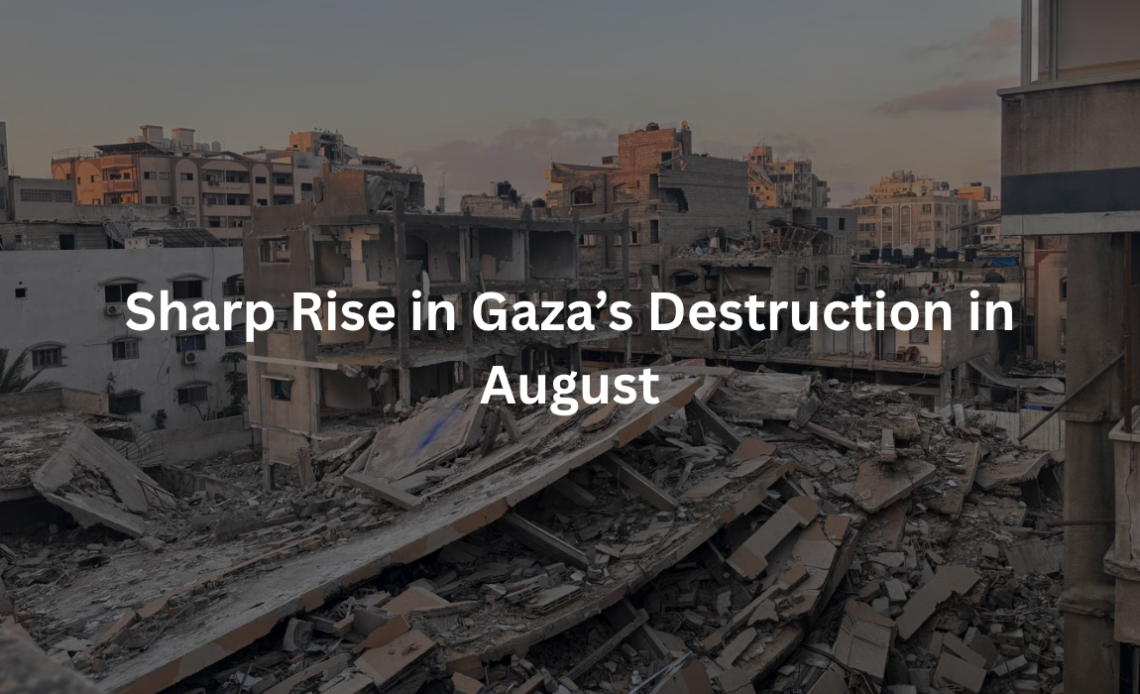
Do you think there is peace in Palestine? Its not in the news any more, so it should be, right? Reality of Gaza’s destruction is opposite. New data released in mid-August 2026 paints a grim picture of a compounding humanitarian catastrophe in Gaza and a rapidly destabilizing West Bank.
Here is a detailed breakdown of the latest reports and developments.
1. Gaza’s Destruction
The “ceasefire” announced in October 2025 has done little to halt the physical annihilation of the Gaza Strip.
According to a new assessment by the UN Satellite Centre (UNOSAT) released this week, the destruction of buildings in Gaza has actually climbed by 9 percent since the ceasefire declaration. The scale of the damage is difficult to comprehend—the UN estimates that approximately 82 percent of all structures in Gaza (about 200,000 buildings) are now damaged, with two-thirds of them completely destroyed.
Even in areas where active bombing has paused, the environment remains lethal. The UN aid coordination office (OCHA) has warned of the ever-present threat of explosive hazards and unexploded ordnance hidden within the rubble.
The human cost of this continued violence is staggering. According to a situation report from UNRWA dated August 12, there have been 1,258 fatalities and 4,295 injuries recorded in Gaza just between the October 2025 ceasefire announcement and August 9, 2026.
2. A Humanitarian Stranglehold
Beyond the direct violence, the operational capacity to save lives is systematically shutting down due to severe supply blockades.
UN agencies report that they are facing insurmountable challenges in delivering essential services. The prolonged shortage of critical supplies, particularly lubricant oil and spare parts required to maintain generators, is forcing systems offline. The impact is immediate and devastating:
- Health Centers: UNRWA operations have already been suspended in more than half of their active health centers. The World Health Organization (WHO) also reported 45 attacks on healthcare facilities between January and August 2026.
- Water and Sanitation: A shocking 95 percent of UNRWA’s Water, Sanitation, and Hygiene (WASH) fleet is deteriorating and malfunctioning due to three years of continuous use and a lack of spare parts, leaving garbage trucks and water tankers out of service. Generators powering water and electricity in seven emergency shelters have also been forced to shut down.
3. The West Bank Powder Keg
While Gaza remains under siege, the occupied West Bank is experiencing an unprecedented surge in violence perpetrated by Israeli settlers.
The situation reached a boiling point in early August in the village of Qusra, south of Nablus. Since August 9, dozens of Israeli settlers have besieged Palestinian homes on the edge of the village, completely severing water and electricity supplies while food runs low. Among the trapped residents are young children.
This siege is part of a much broader campaign. In the month of July alone, more than 360 settler incidents were recorded across the West Bank, including attacks on Palestinians, destruction of property, and the burning of religious sites. Human rights organizations and the Socialist International have warned that this violence—often carried out with near-total impunity—is an enormous obstacle to peace.
According to OCHA, 1,122 Palestinians have been killed in the occupied West Bank since October 2023, with 76 fatalities recorded so far in 2026.
Verdict
The events of August 2026 highlight a grim reality: the international diplomatic process has become entirely detached from the suffering on the ground. A peace plan that demands disarmament while failing to halt the continuous destruction of Gaza’s infrastructure and the rampant settler violence in the West Bank is not a solution. Until the basic human rights, immediate survival needs, and political self-determination of Palestinians are addressed, these high-level negotiations remain little more than a mirage.