


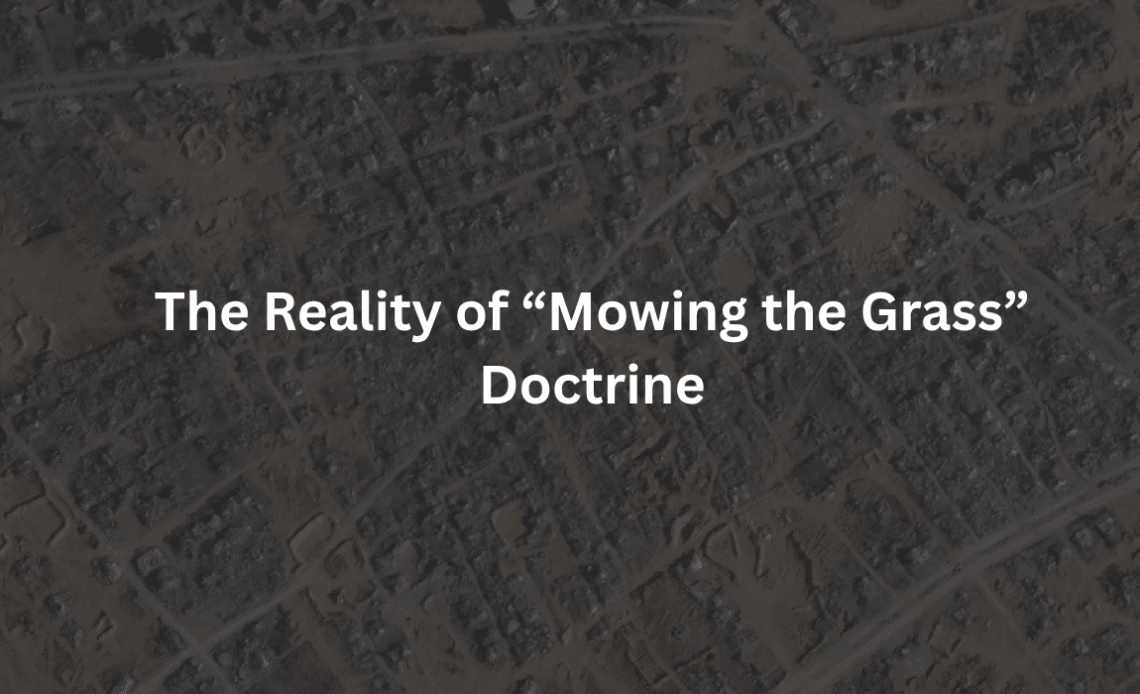
When observing the relentless cycles of violence in Gaza over the past two decades, many international spectators often ask the same question: Why does this keep happening every few years? To understand the systematic destruction of the Gaza Strip, one must look beyond the immediate headlines and understand a specific, chilling concept deeply embedded in Israeli military strategy. In defense and academic circles, it is known as devil’s “Mowing the Grass” doctrine.
What is the Devil’s “Mowing the Grass” Doctrine?
The phrase “mowing the grass” was coined by Israeli defense strategists to describe a patient, cyclical military strategy of attrition. The core premise is deeply cynical: Israel assumes it is locked in a protracted, intractable conflict with Palestinian resistance groups and believes that a permanent political solution is impossible.
Therefore, rather than seeking peace or a final diplomatic resolution, the military goal shifts entirely to “managing” the conflict.
- The Metaphor: In this grim analogy, Palestinian resistance and militant capacity are the “grass.” If left alone, the grass grows. Once it grows too tall, the Israeli military steps in to “mow” it down through large-scale bombardments.
- The Cycle: The objective of these operations is not to completely solve the problem, but simply to degrade infrastructure, destroy weapons caches, and eliminate leadership, forcing a temporary period of quiet. Eventually, the groups rebuild, the grass grows again, and the cycle repeats.
A Strategy Built on Civilian Suffering
For years, this doctrine was the guiding principle behind major Israeli operations in Gaza, including Operation Cast Lead (2008), Pillar of Defense (2012), and Protective Edge (2014).
However, “mowing the grass” is a sanitized, clinical term for a reality that is soaked in civilian blood. When a military strategy accepts periodic warfare as a permanent status quo, it guarantees that every few years, the civilian population of Gaza will face catastrophic loss of life, the leveling of residential neighborhoods, and the destruction of hospitals and schools. The doctrine treats Palestinian civilian casualties and demolished cities as an acceptable, routine cost of maintaining Israeli security.
The 2023-2026 Escalation: When Trimming Becomes Eradication
While the doctrine of “mowing the grass” dictated Israeli policy for years, the unprecedented escalation that began in late 2023 represents a terrifying evolution.
Following the events of October 7, the Israeli military largely abandoned the concept of merely “trimming” capacity. Instead, the strategy shifted toward total eradication. The sheer volume of explosives dropped, the systematic dismantling of the entire healthcare system, and the mass starvation tactics indicate that the goal is no longer a temporary period of quiet, but the permanent rendering of Gaza as an uninhabitable wasteland.
Verdict
The “mowing the grass” doctrine highlights the fundamental failure of treating military force as a substitute for political rights. By accepting endless cycles of violence as a management strategy, the international community allowed the groundwork to be laid for the current genocide. Until the root causes of the occupation are addressed politically, the violence will never truly end—it will only pause until the next deadly harvest.