


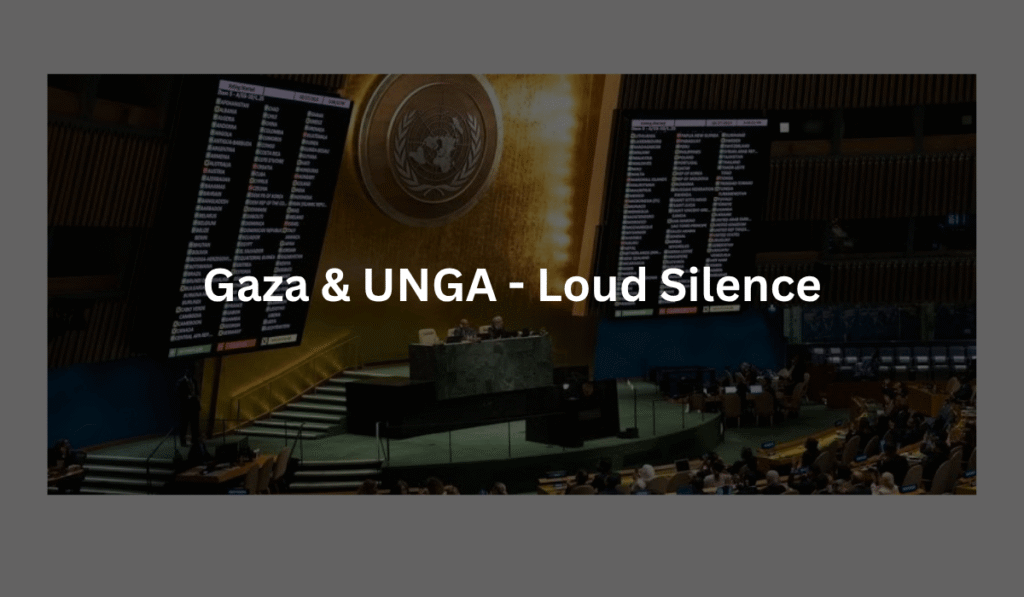
Gaza & UNGA speeches: As the 81st session of the United Nations General Assembly (UNGA) convened in New York this week, the ongoing crisis in Gaza and the rapid expansion of illegal settlements in the occupied West Bank dominated the podium. World leaders lined up one by one to deliver sharp, impassioned speeches condemning the violence. Yet, for the Palestinians enduring daily bombardments and displacement, these grand diplomatic statements are beginning to sound like empty echoes.
Despite the high-profile rhetoric, the stark reality remains unchanged: the machinery of occupation continues to operate with absolute impunity, and the international community has once again failed to produce any enforceable mechanism to stop it.
Gaza & UNGA Speeches – The Loud Silence
Guterres Issues a Stinging Warning
Outgoing UN Secretary-General António Guterres set an unusually sharp tone for the assembly. Reflecting on the devastation in Gaza, he described it as an onslaught “unlike anything I have witnessed in my years as secretary-general.”
Most notably, Guterres aimed his critique directly at the escalating situation in the occupied West Bank. He warned global leaders that continuous violence, mass displacement, and aggressive settlement expansion are not just obstacles to a two-state solution—they are actively “bulldozing the path to peace and raising the specter of ethnic cleansing.”
Speeches Without Solutions
The assembly saw heavy criticism of Israel from various heads of state:
- Brazil’s Pushback: President Lula da Silva boldly accused the Israeli government of perpetrating genocide, stating that generations of Palestinians will carry the trauma of a war waged against women and children.
- Jordan’s Reality Check: King Abdullah II delivered perhaps the most piercing critique of the international system, highlighting the total failure of the much-touted “ceasefire.” He pointed out that hundreds of Palestinian children have been killed even after a ceasefire framework was supposedly agreed upon, bluntly asking the assembly: “What exactly is international law worth, and how can we enforce it if we won’t even call out its violations?”
- Pakistan’s Stance: Foreign Minister Ishaq Dar reinforced the demand for an immediate, unhindered flow of humanitarian aid, warning that the unchecked settler violence in the West Bank is rapidly eroding any territorial foundation for a future Palestinian state.
The Devil’s Defiant Rebuttal
In stark contrast to the global outcry, the Devils’ PM took to the podium to deliver a highly defiant address, prompting scores of international delegates to immediately walk out of the hall in protest.
He dismissed allegations of war crimes as “the biggest lie of the century.” Even more alarming was his dismissal of the skyrocketing settler violence in the West Bank. Rather than addressing the systemic land grabs and military-backed civilian attacks, he minimized the issue entirely, referring to violent settlers merely as a “handful of young juvenile delinquents.”
The Core Issue: No Enforcement
The 81st UNGA has perfectly encapsulated the fundamental flaw of modern international diplomacy. We have treaties, we have international law, and we have global consensus that the rapid annexation of the West Bank and the killing of civilians in Gaza are illegal. But what we lack is enforcement.
When international law is treated as merely a suggestion rather than a binding mandate, every new violation becomes a permanent policy. Until the UN Security Council is willing to back its resolutions with concrete economic or political sanctions, the speeches in New York will remain just that—speeches.