


For the past three years, the entire tech industry has been obsessed with software, with Large Language Models (LLMs) having the best reasoning, which AI agent can code autonomously, and which image generator creates the most photorealistic results. But behind the scenes, a massive hardware bottleneck has been quietly threatening to slow down the entire AI hardware revolution. The models are getting smarter, but they are also getting ridiculously heavy, demanding more memory bandwidth than traditional data centers can physically handle without melting down.
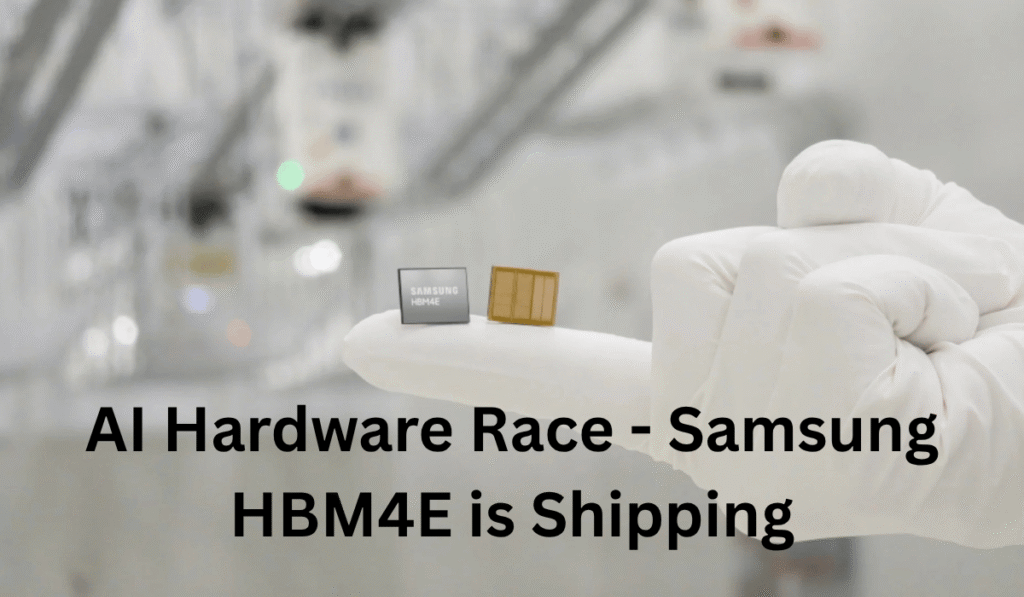
This week, Samsung officially threw a massive lifeline to the hyperscalers. On June 2, 2026, the tech giant announced that it had begun shipping the industry’s very first 12-layer HBM4E (High Bandwidth Memory) samples to major global customers.
Here is a breakdown of why this specific piece of silicon is critical for the future of AI.
AI Hardware Race
1. Breaking the Bandwidth Bottleneck
To run massive LLMs like GPT-5 or Claude Opus efficiently, the processors (GPUs) need to pull data from memory at lightning speed. If the memory is too slow, the expensive GPU sits idle, wasting time and electricity.
Samsung’s new HBM4E is designed to completely eradicate this bottleneck.
- The Speed: The new memory delivers a stable pin speed of 14 Gbps, scaling up to an astonishing 16 Gbps.
- The Capacity: By successfully stacking 12 layers into a single package, Samsung has achieved a 48-gigabyte (GB) capacity per stack. This represents a 30% increase over the previous generation, meaning data centers can fit significantly larger models directly onto the memory nearest the processor.
2. The Power and Heat Problem
Speed is great, but in modern data centers, heat is the ultimate enemy. Running thousands of AI chips generates enough heat to rival a small furnace. If a chip gets too hot, it throttles its performance to survive.
Samsung leveraged its advanced 10-nanometer-class DRAM process and a 4nm logic base die to tackle this issue. The result is a 16% improvement in energy efficiency and a 14% improvement in thermal resistance compared to older models. In simple terms, it moves more data, much faster, while generating less heat.
3. What This Means for the Industry
The timing of this shipment is critical. While companies like Intel and Nvidia (with their new RTX Spark architecture) are pushing the boundaries of what AI chips can do, those chips are entirely dependent on high-bandwidth memory to function at scale.
By securing the first-mover advantage with HBM4E, Samsung is cementing its position as the undisputed backbone of the AI boom. When you prompt an AI to generate a complex video or solve a massive coding architecture later this year, there is a very high probability that Samsung’s silicon will be doing the heavy lifting in the background.
Verdict
The AI software wars might dominate the headlines, but the true battle for supremacy is being fought in the foundries. With the successful shipment of HBM4E, Samsung has effectively raised the speed limit for the entire industry, ensuring that the next generation of AI models has the hardware runway they need to launch.