


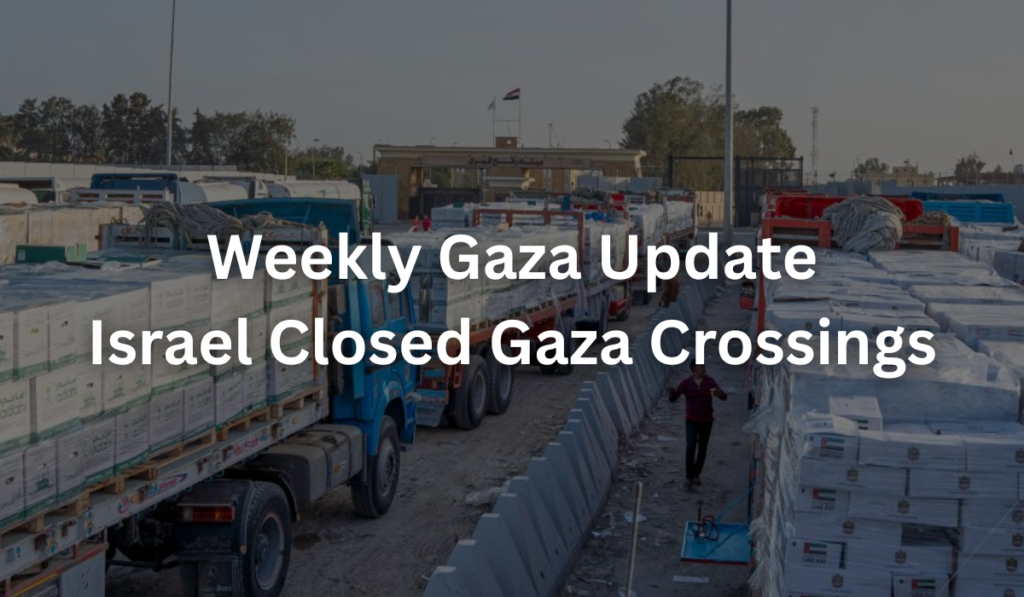
The world’s attention has violently shifted. With the United States and Israel launching unprecedented joint military operations against Iran this week, international media coverage of Palestine has virtually vanished overnight. But for the millions of displaced Palestinians trapped in Gaza, the regional escalation has brought a terrifying, immediate consequence on the ground. Utilizing the cover of the Iran conflict, the Israeli occupation has enacted a new wave of collective punishment. Here is an essential Gaza update for this week while the world looks the other way.
1. Gaza Update – The Sudden Closure of the Crossings
Without warning, COGAT (the Israeli military body managing the Palestinian territory) announced the complete closure of border crossings leading into Gaza and the occupied West Bank “until further notice.”
This includes the vital Rafah crossing with Egypt and the Karem Abu Salem commercial crossing.
- The Pretext: Israeli authorities cited “security adjustments” related to the outbreak of the war with Iran, as well as the Jewish holiday of Purim.
- The Reality: For Gaza, these crossings are the only lifeline. Their closure instantly halts the entry of all commercial goods, international aid, and fuel. Worse still, it completely traps critically ill patients and the wounded who were waiting to evacuate abroad for life-saving medical treatment.
2. Panic Buying and the Threat of Famine
The psychological trauma of the last two years has left deep scars. The moment the crossing closures were announced, sheer panic swept through the enclave.
Residents rushed to local markets in Deir el-Balah and Khan Younis to stockpile whatever basic goods they could find—primarily flour, sugar, yeast, and cooking oil. Within hours, stalls were emptied, and the prices of remaining goods skyrocketed. For families living in tents, the nightmare of the previous man-made famine is returning. Because the majority of the population has been pushed below the poverty line and cash is incredibly scarce, most cannot afford to buy inflated goods, let alone find a safe place to store them in a flooded, winter-battered tent camp.
3. The UN Chief’s Dire Warning
The international community’s response to the closures has been one of deep alarm. United Nations Secretary-General Antonio Guterres issued a stark statement this week, demanding that Israel immediately reopen the border crossings. Guterres explicitly warned of an “Israeli-made humanitarian crisis” unfolding in the shadow of the broader regional war.
With the displaced population entirely dependent on daily humanitarian aid to survive, even a 72-hour halt in food parcel distribution can push hundreds of thousands of people back into starvation conditions.
4. The Blocked Freedom Flotilla
While aid is blocked by land, attempts to break the siege by sea are being actively suppressed. This week, activists from the Global Sumud Flotilla—who were attempting to sail to Gaza to deliver civilian aid—reported being physically confronted and beaten by police in Tunisia after being blocked from departing the Sidi Bou Said port. It is a grim reminder that geopolitical pressure to maintain the blockade extends far beyond Israel’s immediate borders.
Verdict
The unfolding war with Iran cannot be allowed to act as a smokescreen for the silent strangulation of Gaza.
By weaponizing border crossings during a regional crisis, the occupation is exacting a brutal form of collective punishment on a civilian population that has already lost everything. If the “Board of Peace” and the international community do not force the immediate reopening of the Rafah crossing, the starvation we witnessed last year will repeat itself—this time, entirely in the dark.