


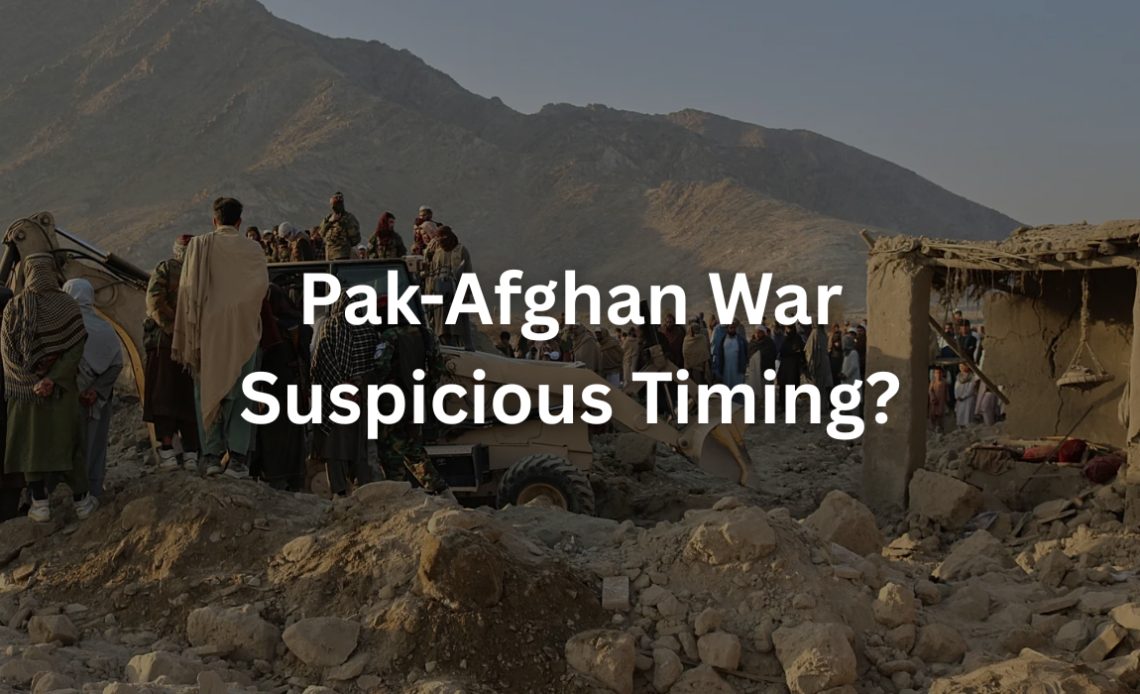
The unthinkable just happened. In a massive escalation that has caught the region completely off guard, Pakistan has essentially gone to war with the Afghan Taliban. Dubbed Operation Ghazab Lil Haq (Righteous Fury), the Pakistan Air Force launched cross-border airstrikes late last night. But these were not the usual border skirmishes. The PAF hit targets deep inside the country, striking military installations in Paktia, the capital city of Kabul, and crucially, Kandahar—the operational base of the Taliban’s supreme leadership. So is the Pak-Afghan War officially on?
Defense Minister Khawaja Asif took to X (formerly Twitter) to make it official: “Our cup of patience has overflowed. Now it is open war between us and you.”
While the military justification—curbing cross-border terrorism—is clear, the timing and scale of this massive offensive raise serious questions. Here is a breakdown of the conflict and why analysts are looking beyond the border.
1. Pak-Afghan War: Operation ‘Ghazab Lil Haq’
The official catalyst for the strikes was a series of unprovoked attacks by Afghan Taliban forces along the Durand Line, following months of deadly TTP incursions (including recent suicide bombings in Islamabad and Bannu). Islamabad issued demarches, and when Kabul failed to act, the PAF crossed the border.
- The Damage: According to the Prime Minister’s spokesperson, Mosharraf Zaidi, and Information Minister Attaullah Tarar, the precise airstrikes destroyed Taliban brigade headquarters, ammunition depots, and logistic hubs.
- The Toll: Islamabad claims that at least 133 Afghan Taliban fighters have been killed and over 200 wounded. Meanwhile, Kabul’s defense ministry claims their retaliatory ground offensive captured Pakistani military posts and killed dozens of soldiers (figures Islamabad vehemently denies).
2. The “India Proxy” Narrative
What makes this escalation different from past border skirmishes is the rhetoric. Khawaja Asif did not just blame the TTP; he explicitly accused the Afghan Taliban of turning Afghanistan into a “colony of India.”
- The Statement: Asif stated that instead of focusing on peace after the NATO withdrawal, the Taliban gathered “terrorists from around the world” and acted as an Indian proxy to destabilize Pakistan, adding that they have deprived their own citizens—especially women—of basic Islamic rights.
- The Strategy: By framing the Afghan Taliban as an extension of New Delhi, the government instantly transforms a complicated border dispute into a patriotic, existential defense of the state, making the military operation virtually immune to domestic criticism.
3. The Suspicious Timing
Political analysts are pointing to the calendar. Why launch strikes on Kabul now?
- The Distraction Theory: Pakistan’s internal political and economic landscape is currently a pressure cooker. A high-profile, patriotic border war is historically the fastest way to unify a fractured public, rally support behind the armed forces, and drown out domestic political opposition.
- Leveraging Global Chaos: With the US entirely focused on the Middle East (the Gaza Board of Peace) and renewed US-Iran nuclear tensions, Islamabad knows that Washington is too distracted to intervene. Pakistan essentially has a geopolitical “blank check” to hammer militant sanctuaries without facing international sanctions or severe Western condemnation.
Verdict
The threat from the TTP operating out of Afghan sanctuaries is undeniably real and has cost thousands of Pakistani lives. However, declaring “open war” on a neighboring country—and dropping bombs on its capital—is a monumental gamble. Whether this is purely a necessary security operation or a calculated geopolitical distraction, the fallout will dominate South Asia for years to come.
Relevant Links for Further Context: