


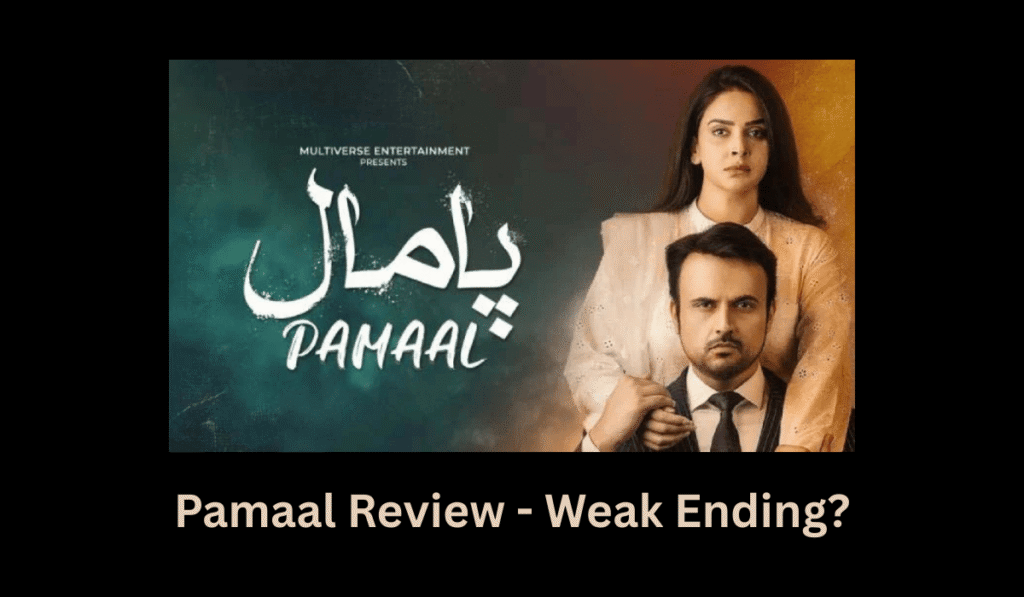
Pamaal Review – Green Entertainment’s Pamaal has finally come to an end. For the last few months, we watched Saba Qamar (Malika) wither away under the suffocating love of Usman Mukhtar (Raza).
Now that the finale has aired, the internet is divided. Some called it a “realistic masterpiece,” while others (myself included) felt the ending was a bit of a cop-out. Here is the final verdict on a show that got so much right, but stumbled at the finish line.
The “Weak” Ending: The Death Trap
Let’s address the elephant in the room. Raza dying was the easy way out. For 20 episodes, the show built up a complex narrative about a woman trapped in a marriage with a narcissist. We waited for Malika to find her voice, to pack her bags, to leave him. Instead, the writers gave Raza a terminal illness.
- Why it failed: By killing off the abuser, the show saved Malika from making the hard choice. It turned her into a grieving widow (which society accepts) rather than a divorced survivor (which society judges). It felt like the writers were afraid to make their heroine “too controversial.”
The “Strong” Message: Defining Silent Abuse
However, despite the weak resolution, Pamaal did something very important: it defined Narcissistic Abuse for the Pakistani audience. Unlike typical dramas where abuse is physical (slaps and bruises), Raza never hit Malika.
- He isolated her. (“Why do you need to see your cousins?”)
- He gaslit her. (“I do this because I love you too much.”)
- He killed her spark. Watching Malika transform from a bubbly, loud writer into a silent, scared shadow was terrifying because it was so subtle. It forced millions of viewers to ask: “Wait, is my husband doing this to me?”
Saba Qamar: The Queen of Nuance
We have to give credit where it is due. Saba Qamar can act with her back to the camera. The scene in the finale where she finally launches her book—not as a wife, but as Malika—was powerful. Her monologue about “losing yourself to find yourself” saved the episode.
The Verdict
Pamaal wasn’t perfect. The pacing was slow, and the ending was convenient. But it started a conversation about emotional control that we desperately needed. It showed that just because he doesn’t hit you, doesn’t mean he isn’t hurting you.
Rating: 3.5/5 Stars.
Did you find the ending satisfying, or did you want Malika to leave him before he died? Let me know!