


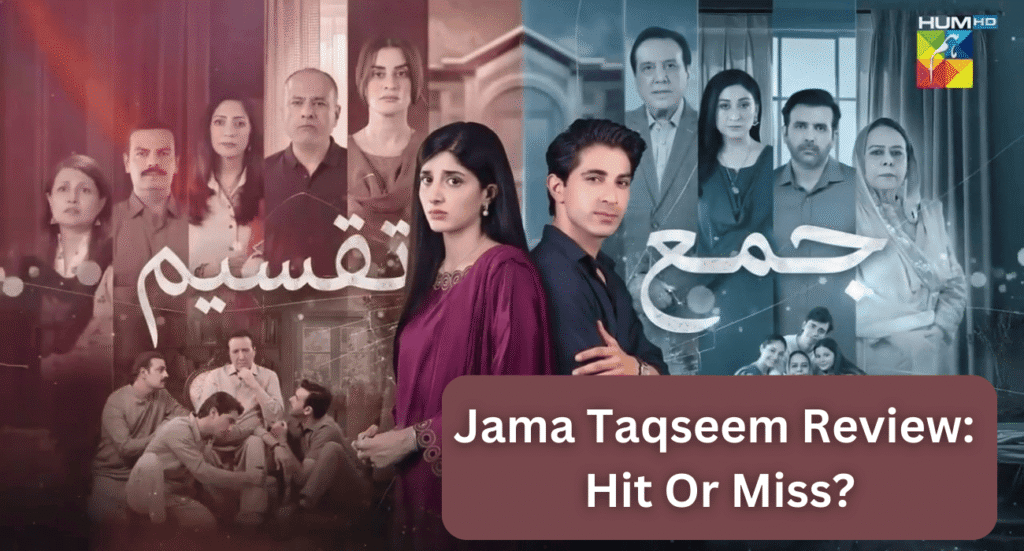
For the past 25 weeks, HUM TV’s Jama Taqseem has been a mirror held up to the uncomfortable reality of the desi “Joint Family System.”
Unlike the usual saas-bahu scream-fests where villains plot murders, Jama Taqseem was terrifying because it was quiet. It showed the slow, suffocating death of privacy, the financial manipulation by elders, and the way “tradition” is weaponized to control the younger generation.
Yesterday, the show aired its final episode (Episode 30). While social media is flooded with “Happy Ending” edits, I am left feeling conflicted. Did the show actually solve the problems it raised, or did it just sweep them under the rug for a pretty final shot?
Here is the deep-dive review.
The Good: Breaking the Silence
Before we critique the end, we must give credit where it is due. Writer Sarwat Nazir gave us some of the bravest storytelling of 2025.
1. The “Sidra” Arc (The Harassment Taboo) The standout performance wasn’t the leads—it was Nazeeha Zainab as Sidra. The subplot involving her harassment by her own cousin, Zeeshan (Elahi Bux Khan), was gut-wrenching. Usually, dramas ignore “cousin harassment” to protect the sanctity of the family image. Jama Taqseem showed it in its ugly detail: the gaslighting, the “he is your brother” excuses, and the fear of speaking out. When Qais (Talha Chahour) finally stood up for her in Episode 24, it was one of the most satisfying moments of Pakistani TV this year.
2. The Economics of Control The character of Rafiq Sahab (Javed Sheikh) was a masterclass in patriarchal control. He wasn’t evil; he was just… rigid. The show perfectly depicted how elders use “pooling income” as a way to strip their sons of financial independence, ensuring they can never leave the house. It was a subtle, necessary critique of how financial abuse is often disguised as “family unity.”
3. Mawra & Talha’s Chemistry Mawra Hocane (Laila) and Talha Chahour (Qais) played the “suffocated couple” perfectly. Their chemistry wasn’t about grand romantic gestures; it was about stolen glances in a crowded hallway and whispering in their bedroom because the walls were too thin. It felt real.
The Bad: The “Forced Forgiveness” Trap
This is where the show lost me.
In the final episode, the narrative shifted aggressively towards “reconciliation.” After 29 episodes of showing us that Zeeshan was a predator and Rafiq Sahab was controlling, the finale asked us to forgive them because… “family is family.”
- The Zeeshan Redemption: Zeeshan’s apology felt rushed and unearned. A character who harasses women doesn’t change overnight because of one lecture. By reintegrating him into the family circle so quickly, the show diluted the severity of his actions.
- The “Joint” Conclusion: The ultimate message seemed to be: “The joint family system is flawed, but you should stay in it anyway because leaving is selfish.” Laila’s struggle for a separate home—which was validated as a religious and legal right throughout the show—was framed in the end as a “compromise” she had to make for the greater good.
The Verdict
Jama Taqseem was 90% a masterpiece and 10% a disappointment.
It successfully exposed the cracks in our family structures but lacked the courage to shatter them completely. It told women to speak up against injustice, but in the end, it also told them to forgive their abusers for the sake of a nice family photo.
Final Rating: 4/5 Stars (for the acting and bravery), but 2/5 Stars for the resolution.
Do you agree? Should Laila and Qais have moved out, or was the happy family ending the right choice? Let me know in the comments!