


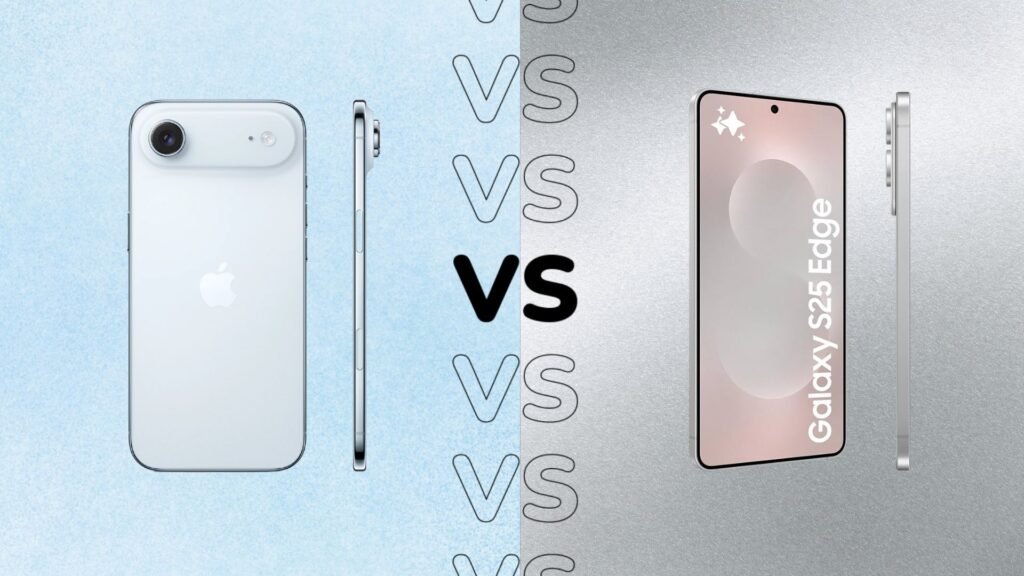
This was the year of “thin”. At their launch events, Apple, Samsung, and Motorola presented their new flagships as engineering marvels. The thinnest phones are here. The iPhone Air (at a razor-thin 5.6mm), the Samsung Galaxy S25 Edge (at 5.8mm), and the Motorola Edge 70 felt like something out of a sci-fi movie. Holding one is a “wow” moment. They are sleek, impossibly light, and feel futuristic.
And now, just two months later, the trend is an undeniable failure.
Check our iPhone 17 review here.
Recent reports confirm that Apple is already slashing production of the iPhone Air due to “disappointing sales performance.” Samsung is facing a similar reality, with S25 Edge sales described as “incredibly lackluster.”
It turns out, we, the consumers, were not asking for this. In their obsessive “war on thickness,” these companies compromised on the three things we actually care about: cameras, battery life, and durability.
1. The Camera: A $1,000 Phone with One Lens?
The most glaring, unforgivable sacrifice is the camera.
To achieve its 5.6mm profile, Apple had to make a choice. The result? The iPhone Air, a $999 (~PKR 300,000+) “premium” device, has a single-lens camera system.
Let that sink in. In an era where even budget phones have dedicated ultrawide and telephoto lenses, Apple is selling a flagship-priced phone with the camera capabilities of an iPhone from 2017. There’s no optical zoom, no ultrawide. You are paying for “thinness” with one of the most-used features of a smartphone.
The S25 Edge and Edge 70 managed to keep their multiple lenses, but they, too, suffer from smaller, less capable sensors that can’t compete with last year’s S24 Ultra or even the iPhone 16 Pro.
2. The Battery Lie: “All-Day” (If You Don’t Use It)
This was everyone’s first question: where did the battery go?
The physics is simple: a thin phone means a thin battery. The iPhone Air has a tiny 3,149mAh battery, and the S25 Edge a 3,900mAh one.
Reviewers have noted that “software optimization” makes the battery life “respectable” or “decent” if you’re just browsing the web or watching videos. But the second you do any real-world tasks, the house of cards collapses.
For a Pakistani user, “decent” isn’t good enough. Fire up a 30-minute session of Call of Duty Mobile or PUBG, and you can physically watch the battery percentage drop. These phones suffer from constant “battery anxiety.” They are built for a perfect world of light use, not the reality of a power user.
3. The “Snap” Factor: Fragile, Impractical, & Hot
This is where the trend becomes a literal scam.
- Durability: The Samsung S25 Edge is a durability disaster. While it surprisingly passes bend tests, recent drop-test videos are horrifying. The new “Gorilla Glass Ceramic 2” screen and glass back reportedly cracked on the very first drop from pocket height.
- The “Case” Irony: This fragility means that the first thing every owner must do is buy a thick, protective case. This completely defeats the entire purpose of the phone. You are paying a premium for a thin design just to hide it in a bulky plastic shell.
- Overheating: A thin chassis has no room for a proper vapor chamber or cooling system. The Motorola Edge 70, just like its predecessors, is already notorious for overheating. The S25 Edge and iPhone Air also suffer from severe thermal throttling. This means during a long gaming session, your brand-new, expensive 2025 phone will get hot, slow down, and perform worse than last year’s thicker, “outdated” models.
Conclusion: A Trend We Must Reject
This entire “war on thickness” is a failure because it’s a solution to a problem nobody had.
No one was complaining that their iPhone 16 Pro or S24 Ultra was “too thick.” We were asking for better batteries, stronger screens, and more powerful cameras.
Instead, we got a marketing gimmick. The iPhone Air and S25 Edge are design trophies for executives, not practical tools for people. The good news? The market is already rejecting them. The bad sales are proof that we value function over form.
My advice for anyone in Pakistan with a big budget: Do not buy these phones. Save your money. Go buy last year’s “thicker” iPhone 16 Pro or S24 Ultra. They are stronger, last longer, take better pictures, and are now cheaper.
They’re just not as good at being thin. And that’s a trade I’ll take every single time.